I read this (epub) on 15 May 2026.
This novel is up for a 2026 Hugo Award. If you become a voting member, you can download the voters packet and read it yourself.
Magic-school stories, which I suppose are a subset of boarding-school stories, are not my jam. Not anymore.
I was a Harry Potter kid. Like, the original generation. The second book was a gift to me the year it came out, when I turned 11. I hit almost every midnight release after that. Some of my adulthood pets were named for characters. My first tattoo is a deathly hallows (which I do not regret but will not get touched up). I learned to love Harry Potter uncritically, uncomplicatedly.
I was raised on golden age sci-fi and had slowly come to understand that the works were more racist and sexist and phobic than I had ever realized, and that there’s only so much that can be written off as being a product of the times… but I was unprepared for the unravelling of my love for JKR’s work.
It’s left a bad taste for school stories. (And for faction stories, sorry The Raven Scholar.) Also, I keep getting older and older, and I’m deliberately childless, so relating to the school environment gets harder and harder. I remember rather liking Magic for Liars from Sarah Gailey, which is about adults dealing with murder at a magical high school.
I enjoyed reading The Magicians from Lev Grossman… but I didn’t have any desire to read more of it, and never touched the subsequent books. I kinda didn’t care. It felt like competently written rehash of C.S. Lewis and J. K. Rowling specifically for people my age who wanted more content with an adult edge, but I wasn’t compelled. I’ve never felt an urge to watch the show, either.
I’m sure there are other comps, but those are the ones that come to mind. Anyway, I liked this a bunch.
Seeing the magic/boarding school from the teacher/admin side was a nice change, and the text did a great job of showing the educator’s passion. I liked the explicit framing of teaching techniques, and the moments where the narrator realized a different approach would have been better.
My favorite line from this book, which I think will stick with me, comes from a section where a student who has trouble expressing themselves is groping for the right word to explain the vibe/intuition they’re feeling.
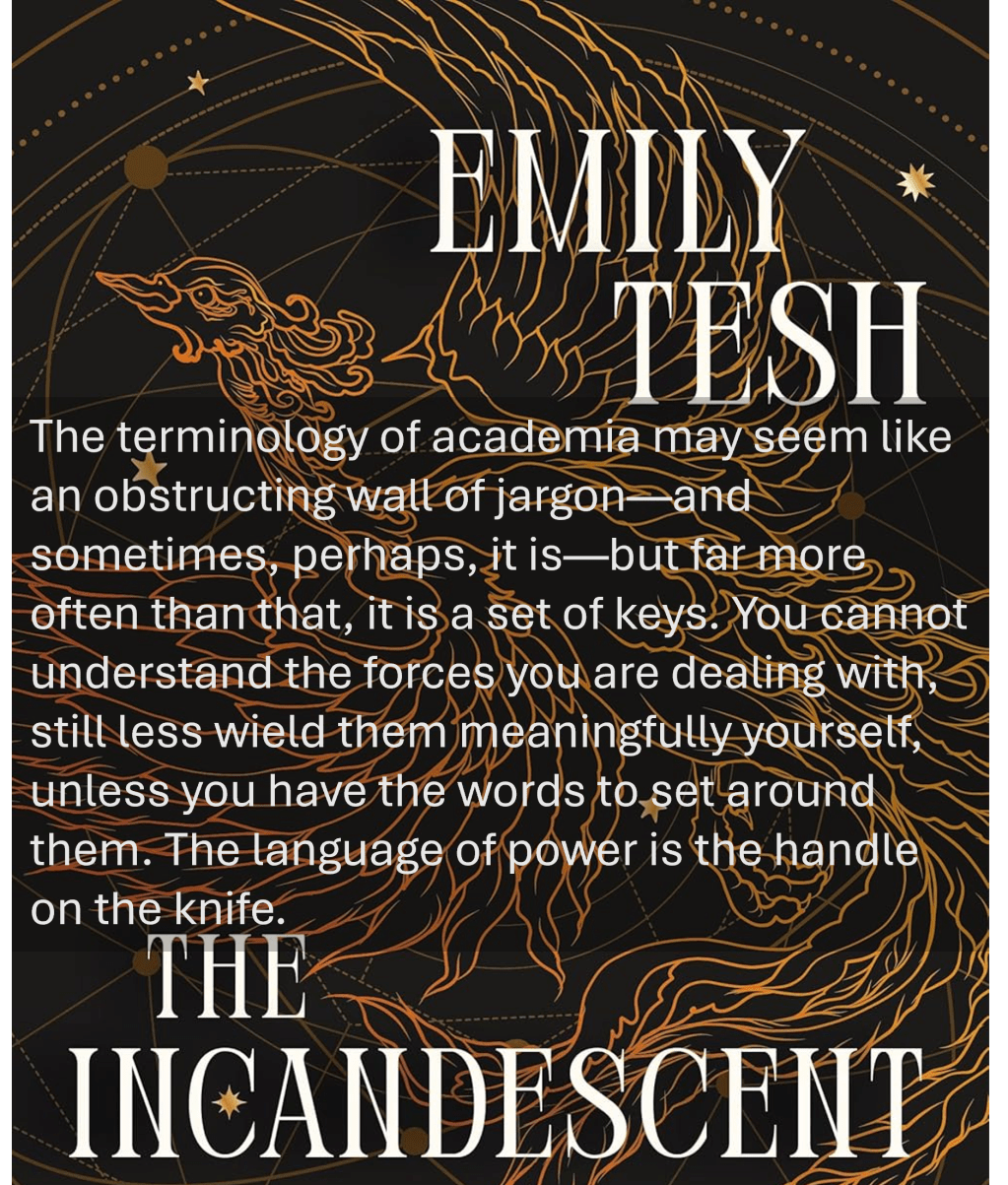
The terminology of academia may seem like an obstructing wall of jargon—and sometimes, perhaps, it is—but far more often than that, it is a set of keys. You cannot understand the forces you are dealing with, still less wield them meaningfully yourself, unless you have the words to set around them. The language of power is the handle on the knife.
Chapter 28
It is a decent paragraph and makes a lot of sense in context, but I really love that last line.
I’ve mentioned being pedantic. Also, I work in a field where terminology is important but also there are so many people of varying skill/knowledge levels that consistent terminology is frustratingly rare and usually not well respected. This paragraph speaks to me.
I suppose that any academic rigor applied outside of academia is going to feel simultaneously empowering and misguided. Our narrator frequently boasted of her academic credentials in the face of practical-user skepticism, and the main underlying plot relies on that academic bravado being somewhat misplaced – she was in fact in over her head. Then again, she understood how things worked and how to apply that working, and her original error was not as dire as the non-academics had thought. The book doesn’t give either side a neat moral victory, which I appreciated.
The line about language (and I think academia writ large) has made me think most clearly about my own reviews and writings here. A good critic or reviewer should be able to describe how and why something is good or valuable, and should be able to put their thoughts into useful words. This is perhaps self-evident, but then again this is the internet.
I’m not holding myself to a particularly rigorous standard with these Hugo nominee reviews because I would let perfect become the enemy of good enough. That said… hopefully this will all serve as some sort of inspiration to be more consistent and coherent as these reviews continue. (I seem to have had lofty ideals about developing a writing practice back when I bought this domain name three years ago… and you can see where that got me.)
Anyway, good book. Glad it was queer but wish I felt better about the massively telegraphed bad decision to liaise with the “arsehole sandwich” of a privileged straight white man. Wish the sapphic ending didn’t feel rushed but there’s room to make a uHaul joke (do Brits have that joke?).
Also, I really liked the final sentence. Endings are something I struggle with.


Leave a comment