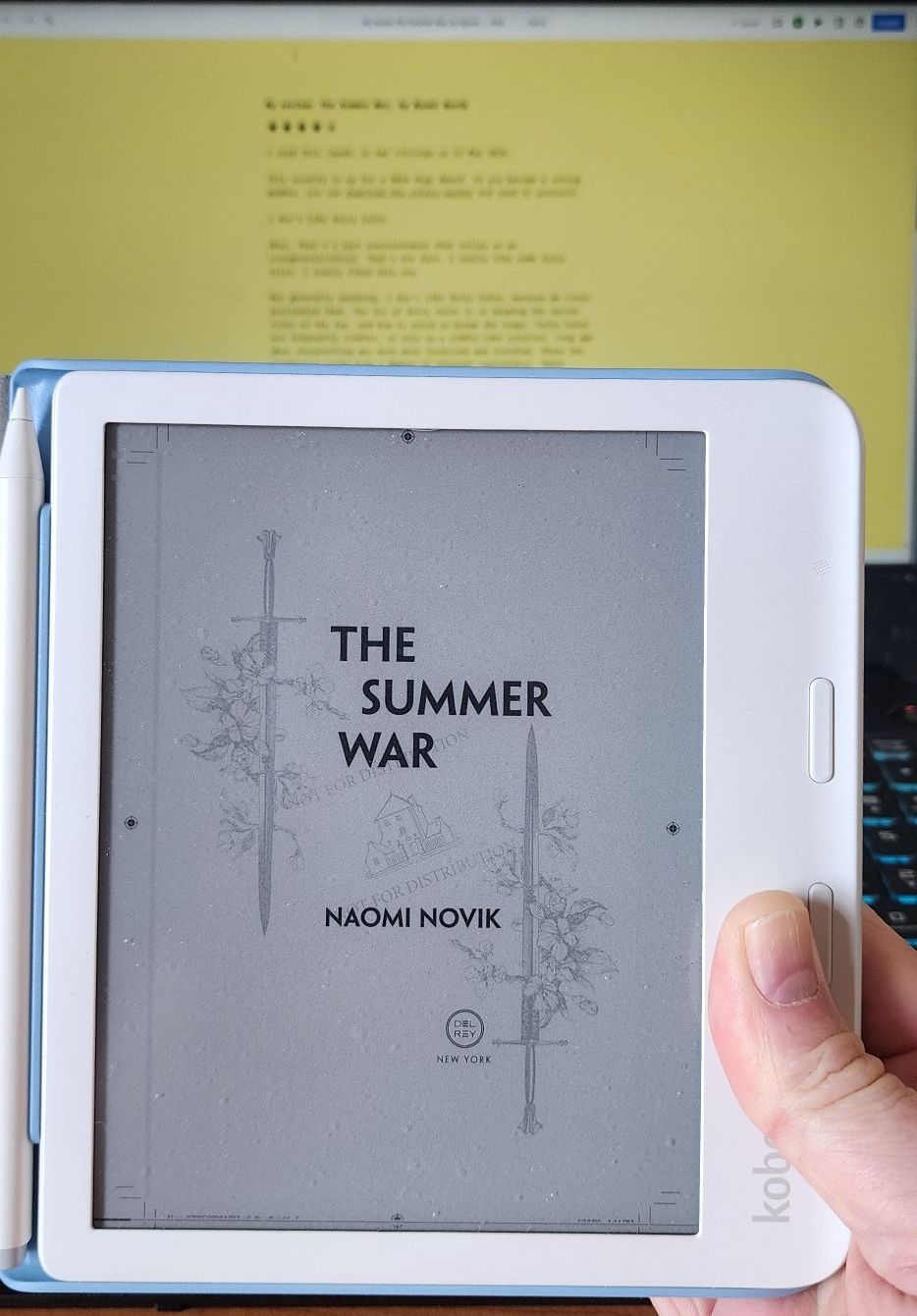
I read this (pdf) in two sittings on 12 May 2026.
This novella is up for a 2026 Hugo Award. If you become a voting member, you can download the voters packet and read it yourself.
I don’t like fairy tales.
Okay, that’s a vast overstatement that relies on an overgeneralization. That’s not fair. I really like some fairy tales. I really liked this one.
But generally speaking, I don’t like fairy tales, because we cross-pollinated them. The joy of fairy tales is in knowing the secret rules of the fae, and how to avoid or break the traps. Fairy tales are frequently riddles, or rely on a riddle-like solution. Long ago when storytelling was much more localized and isolated, these fae traditions could grow a degree of internal consistency. There weren’t enough new ideas spread widely enough quickly enough to break the continuity. Sure, Germanic fae and Celtic fae were very different, rules-wise, but you only ever saw one at a time and didn’t know there were inconsistencies.
Nowadays, any decent author can write a really good fairy tale that includes their own slant on how something works. We all agree that you should never ‘give’ a fairy your name, but each author can come up with a new reason why that matters and a new explanation of how it works… and sometimes those new explanations also create new loopholes. Frequently that’s necessary to the story, but it can create a sense of deus ex machina if not adequately set-up, and it can invite continuity errors even within the story.
I love this story and will have to reread it before I vote, but upon first reading I have to say that I’m annoyed at one such break. There are some plot spoilers below, because I couldn’t explain my gripes without talking about the story.
Our heroine Celia is captured by the fae Prince of Summer, and wants rescuing (I’m also annoyed that despite Celia being a powerful sorcerer, she is trapped powerless in a tower and needs rescuing). Her half-brother Argent, a great knight, had previously disavowed their shared father Veris, and so when he comes to rescue Celia, the Summer Prince rejects his claim – they are not kin if Argent rejects the father they share.
Later, the third half-sibling, Roric, comes disguised, and woos the Summer Prince with his singing and storytelling. He craftily hesitates when asked for more. He has a song he would love to sing, but he fears it would anger the court. Before he agrees to sing it, he gets the Prince to promise there will be no retribution against him or his kin. Only after singing the song and explaining the brutal insult (i.e. truth bomb) it contains, he then reveals that Argent and Celia are his kin, who were just granted protection.
Except just a day prior, the Prince had said Argent’s self-emancipation had invalidated his family ties to the other children. Somehow, this time that familial bond still holds? This goes unaddressed.
Additionally, there’s unclear mental gymnastics involved in circumventing the various oaths, feuds, curses, and promises. If the Summer Prince renounces his claim on Celia, then he can save face and avert the other crises, but he refuses… until suddenly he changes his mind? And when Veris comes to save all his children (well honestly mostly just Celia), he argues that Celia was never a princess and so she does not technically meet the requirements that led to her capture in the first place? That’s a tidy solution but it means all the drama with Argent and Roric was unnecessary?
Also, there’s a solution where the Summer Prince, denied his not-really-a-princess wife of Celia, is given Argent, who becomes a prince after Celia becomes the mortal queen. Fine. Except Argent isn’t a sorcerer, which was the other part of the requirement.
The book is titled The Summer War but I really like the idea that the war is over before the book begins. That’s neat. We learn it is more complicated than that (of course, why else would you have that title) but it is a fun naming idea. Unfortunately, there is in fact a lot of war mentioned, if not shown, and it is all brutal war-crimes. The conceit is that the fairies love glorious war (it sounds better in the original Klingon) and they venerate their most hated opponents. So we get a litany of devious murderous slaughters that we’re supposed to see as… noble? Clever? It doesn’t work for me, but I can accept that it works for the fae.
Later, we get one-on-one combat as Argent tries to win Celia back from the Summer Prince (who has already said that this isn’t on the table). It’s not too graphic or explicit, but our hero does kill 100 opponents in single combat. The fae are loving it, and don’t mind the losses, and are even eager to be the next in line, to either triumph or fall in glory, and to live on in song either way.
Not Argent, though. He’s confident and ruthless and brutal. Not quite murderous, but definitely very willing to just keep killing people. This might be due to his curse, or due to his desire to break his curse, but we get no nuance or insight. We just seem him drop body after body while our narrator is stuck in her tower.
Arguably, this is set up for Argent’s happy ending in the fae realm, but… it makes him feel unrealistic and unlikeable to me.
War is war, as Hawkeye said. I can forgive the fae for being written as a completely different kind of creature with a different perspective on war, battle, honor, and death (the author does an okay job of explaining this, but definitely also relies on the zeitgeist). I cannot quite accept the human characters’ inhumanity, however.
Look, I really enjoyed the ride, but the harder I look at the construction of the parts, I see how shaky the premise is. (There could be a metaphor about carnival rides or something.) I will read it again to see if the parts fit better now that I know what I’m looking for.
Also, an interesting thing I learned from the ‘about the author’ section at the end: Naomi Novik was an original organizer of the OTW (Organization for Transformative Works) and a co-founder of AO3 (Archive of our Own). Neat!


Leave a comment