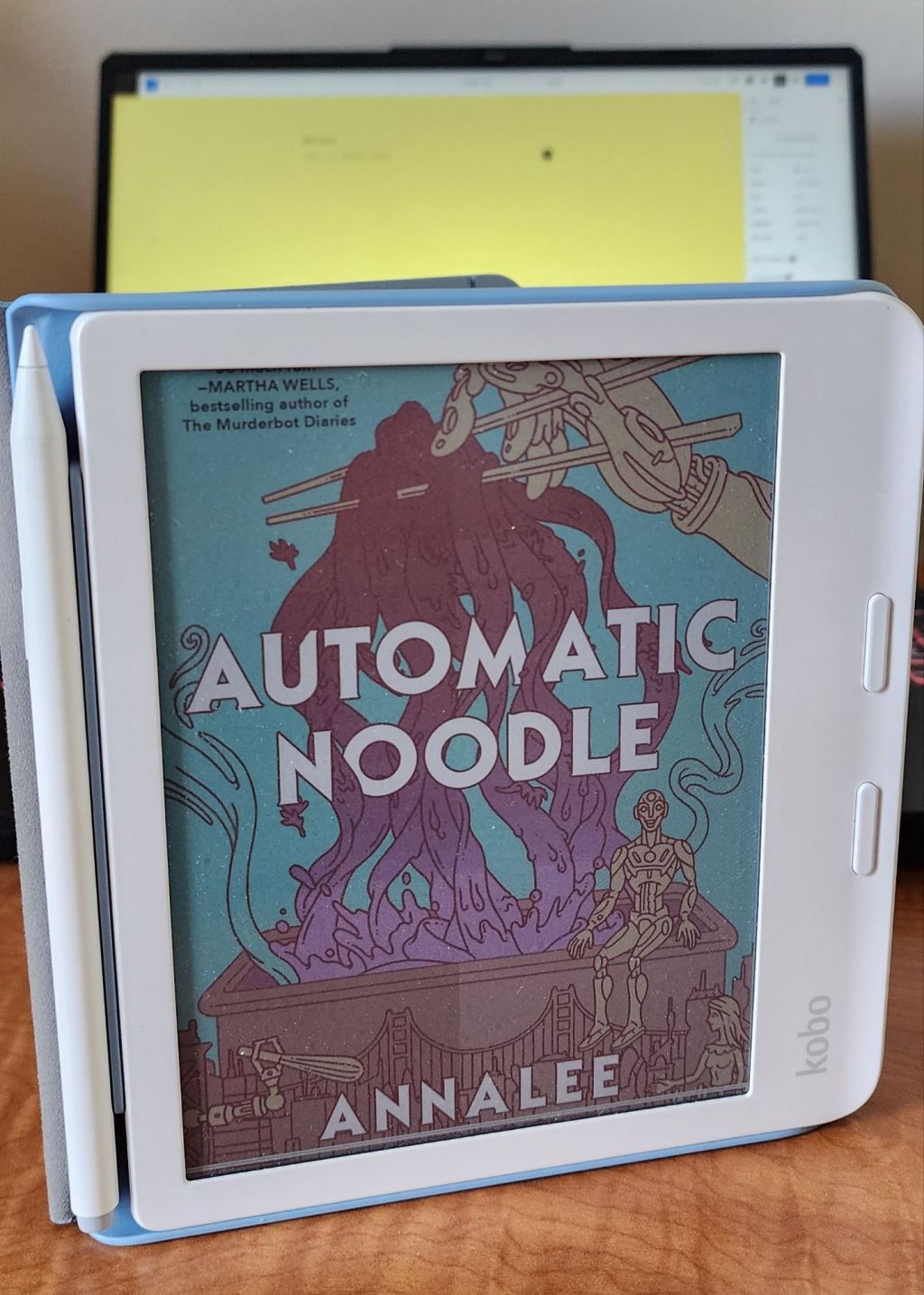
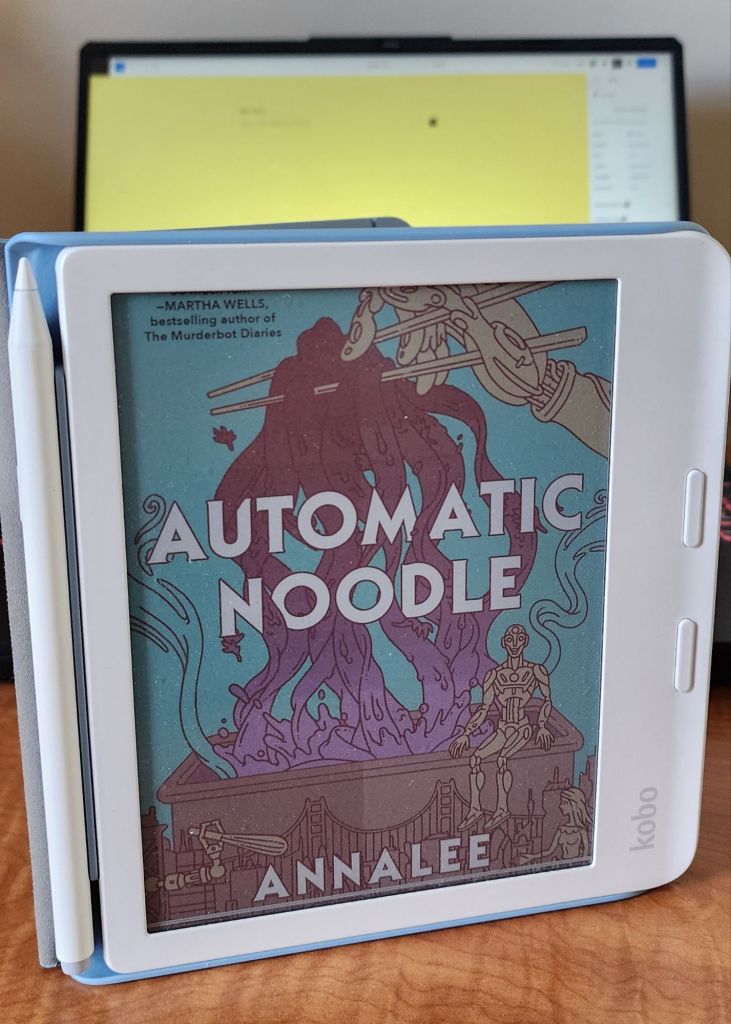
I read this (epub) in two sittings on 11 May 2026.
This novella is up for a 2026 Hugo Award. If you become a voting member, you can download the voters packet and read it yourself.
The truest sign of a book I love is my desire to share it with other people. Sometimes this can be artificially inflated, if the book is only mediocre but hits on tropes or themes that make me think of someone. Other times it can be harder to hit this mark, if I love a story but don’t know who, exactly, to share it with.
This book sits in the middle. I want to share it with my mom because it is about cooking, which I think she’ll like. But also I’m pretty sure the robot bits won’t do much for her, and she probably won’t understand the trans allegories, and I know she’ll struggle with the literally poopy parts.
I’m eliding the fact that I’m very wary of sharing any stories that prominently feature war trauma. What with the war trauma, and all. Not every joke is a confession.
Anyway.
It’s a great book. So far it is my favorite for the Hugo. Then again, I’ve only read two of the six, and I also really loved the other, so… maybe too soon to metagame.
The story is about a crew of restaurant robots who discover they’ve been abandoned by the human owners of their ghost kitchen. They live in an Independent California that has granted limited rights to Human Equivalent Embodied Intelligences (i.e. robots as smart a people, different from the “puppy grade” and less capable bots that also populate the universe).
I could be more savvy on the real world’s slow crawl towards civil rights and equality, but it is pretty clear that these robots are confronting a new version of all the bigotry and discrimination that we would like to think we’ve solved, and their ‘happy’ life in the ‘free’ land of California is definitely better than it was before, or in neighboring America, but they’re just reinventing all of the new hurdles faced by Black people and women in the 1900s. For instance, the robots are free to choose where they work, but they cannot legally hold bank accounts or real estate.
The author does a great job of incorporating these barriers into the narrative without heavy lore drops or manifestos, and the equivalencies to real human history are not ever directly addressed.
I would like to think a young reader today would be outraged on behalf of the repressed bots, without ever realizing that every line item is a direct quote from history.
That said, the story moves quickly, without moping. Each character has their turn to be depressed and to struggle, but their little community is so warm and supportive that they each process through and move on.
The robots, as I said, wake up to discover they’ve been abandoned and are at risk of becoming liquidated assets. They decided to open their own restaurant, together, working only for each other, and carve out a little niche of stability and community for themselves and their neighborhood.
This is not the only book I’ve heard compared to Becky Chambers this year. Other readers and reviewers are right to make that comparison, but comps like that always feel too narrow.
The term I would use is “hopepunk” but I don’t even know if that’s still in vogue. “Cozy” gets used a lot, and this is that, too.
If you want to read something that makes you hungry for noodles, or that makes you happy for queer spaces, or that makes you angry at bigotry, then this is a great book. Those are all weirdly specific reasons to read a book, though, so I doubt you’re going to find this review by searching for those terms.
Try searching for “Authentic Noodles” and you might find what you’re looking for.


Leave a comment